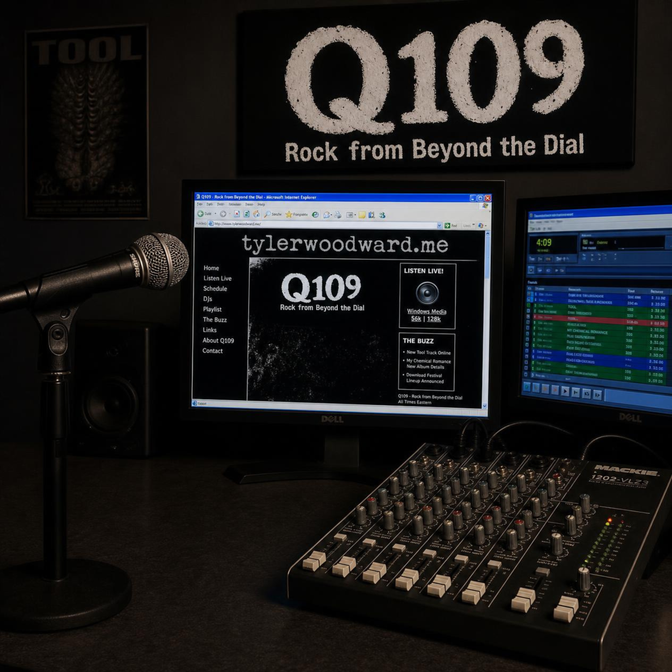
In 2009 I ran an internet radio station called Q109, Rock from Beyond the Dial. I had my own Icecast server running, and a company called SWCast handled my music licensing behind the scenes. I streamed rock music to whoever wanted to listen, completely legally, before I'd even started my career in broadcast engineering.
Then the hammer came down on SWCast. They'd gotten caught not passing royalty money through to SoundExchange correctly, collecting licensing fees from people like me and pocketing part of it. SoundExchange figured it out, SWCast folded, and my license disappeared with them. I wasn't going to rebuild the whole thing from scratch, so Q109 went dark. I filed it away as something I used to do.
Recently I started actually considering doing it again. I've got a lot of music I want to play, and I wanted to dust off the old skills. Live365 is still around, though it's not the same company that owned it back in 2009. But the price tag stopped me: around 70 bucks a month at the hobbyist tier.
Every recorded song carries two separate copyrights. One covers the composition, the melody, the lyrics, the underlying musical work, and that's handled by performance rights organizations like ASCAP, BMI, SESAC, and GMR. The other covers the actual sound recording, the specific performance you're hearing, and that's SoundExchange's territory.
Terrestrial AM and FM radio has only ever had to pay the composition side. Over the air broadcasters have never paid SoundExchange a dime for the master recordings they play, an exemption baked into US law from the start. Webcasters pay both, and have since the DMCA made it law in 1998.
Right now the SoundExchange rate for a non subscription commercial webcast sits at a quarter of a cent per performance, where one performance is one song played to one listener. Run 12 songs an hour to 20 consistent listeners and that's 240 performances an hour, adding up to three or four thousand dollars a year in per performance royalties alone. On top of that there's a minimum fee of a thousand dollars a year per station just to participate, whether anyone's listening or not.
In 2009, small webcasters had reduced, revenue based rates that acknowledged the difference between a hobbyist and a company like Pandora. That went away at the end of 2015, when the Webcaster Settlement Act expired and the Copyright Royalty Board replaced it with a flat per performance rate for everyone. That's the ruling that killed off the original Live365 in January 2016, sending thousands of independent stations dark overnight.
Assembling the licensing stack yourself means a SoundExchange minimum of a thousand dollars a year, BMI starting around 350, ASCAP around the same, plus two organizations that don't even publish their rates publicly. Add in monthly reporting requirements, tracking every song played and to how many listeners, and realistic DIY costs land north of 1,700 dollars a year before anyone has actually tuned in.
I want to be clear that I'm not saying artists and labels shouldn't get paid. SoundExchange exists because webcasters were playing music and the people who made it weren't seeing a dime, and that was a real problem that needed fixing. But the rate structure they fixed it with doesn't distinguish between a hobbyist station running out of a closet to 30 people and a company worth billions doing the same thing. Pandora, now owned by Sirius XM, can absorb that rate across hundreds of millions of listeners and build a business model around it. A retiree who wants to stream classic rock to his friends can't clear the thousand dollar minimum before anyone's heard a single song.
The law that was supposed to level the playing field ended up entrenching the advantage of scale.
If I were doing this today, I'd go with Live365 and pay the monthly fee rather than build the stack myself, because the alternative isn't viable at the scale I'd want to run at. Q109 isn't coming back, not because I don't want it to, but because I genuinely can't afford it anymore. Might just build some Spotify or Apple Music playlists instead.
Apple Podcasts: https://tylerwoodward.me/applepodcasts
Spotify: https://tylerwoodward.me/spotify
YouTube: https://tylerwoodward.me/youtube
RSS: https://tylerwoodward.me/rss

